As an Amazon Associate I earn from qualifying purchases. Hamejur's conclusions remain editorially independent.
Kitchen & food · Probe and food-safety guide
Short answer: the best instant-read thermometers for home cooking are easy to place correctly, read safely, clean, and verify. Choose the OXO Thermocouple for its rotating probe control and broad-angle handling, the Lavatools Javelin PRO Classic for a large display and stabilized-reading hold function, or the TempPro TP19H for a straightforward foldable set with calibration and AAA power. Response claims matter less than reaching the food’s true center and waiting for a stable reading.
Disclosure: As an Amazon Associate I earn from qualifying purchases. Hamejur does not receive payment for choosing one model over another. Prices, availability, colors, package contents, and specifications can change, so confirm the exact model before ordering.
Quick verdict
Best handling pick: OXO Thermocouple. Its dial-open probe and rotating screen reduce awkward contact, while the owner still needs correct insertion and cleaning.
Best display-and-hold pick: Javelin PRO Classic. The large screen and stabilization control help at difficult angles, provided splash resistance and legacy naming are understood.
Best core-feature pick: TempPro TP19H. It covers the expected fold, rotate, hold, calibrate, wake, and magnetic-storage routine, with a visible brand transition to confirm.
The three picks at a glance
HANDLING PICK
OXO Good Grips Thermocouple Thermometer
A thermocouple tip, 225-degree rotating probe, auto-rotating backlit screen, dial-style opening control, and IP66 body favor fast checks from varied angles.
Watch for: the body is larger than a basic pocket probe, its published accuracy is a manufacturer specification, and waterproof construction still requires the exact cleaning instructions.
DISPLAY + HOLD PICK
Lavatools Javelin PRO Classic
A two-inch auto-rotating backlit display, 4.5-inch tapered probe, hold-and-stabilization control, motion wake, magnet, and IP65 splash resistance suit awkward views.
Watch for: the current product page still uses the older “PRO Duo” name in some feature text, so confirm the PRO Classic identity and exact color ASIN before ordering.
CORE-FEATURE PICK
TempPro TempSwift PLUS TP19H
A folding four-inch probe, auto-rotating backlit display, hold, user calibration, motion wake, magnet, hook, IP65 rating, and AAA battery cover the core routine.
Watch for: the brand changed from ThermoPro to TempPro, packaging may show either name, and the current one-second response remains a manufacturer claim rather than an independent result.
How Instant-Read Thermometers for Home Cooking Compare
| Decision factor | OXO Thermocouple | Javelin PRO Classic | TempPro TP19H |
|---|---|---|---|
| Sensor | Thermocouple tip | High-sensitivity tapered probe sensor | NTC sensor |
| Published response | 2–3 seconds | Typically 2–3 seconds | 1 second manufacturer claim |
| Display and handling | Auto-rotating backlight; 225° dial-open probe | 2 in. auto-rotating backlight; hold and beep | Auto-rotating backlight; hold and motion wake |
| Published water rating | IP66 | IP65 splash resistant | IP65 |
| Battery | AAA | CR2032 button cell | AAA |
| Best fit | Varied angles and low-contact opening | Large display and reading hold | Straightforward everyday feature set |
Published response and accuracy figures come from manufacturers under stated conditions. Food shape, insertion depth, temperature gradient, probe contact, battery, damage, and the time allowed to stabilize affect a real reading.
Choose instant-read thermometers for home cooking by measurement routine
Match the sensing tip to the food’s center
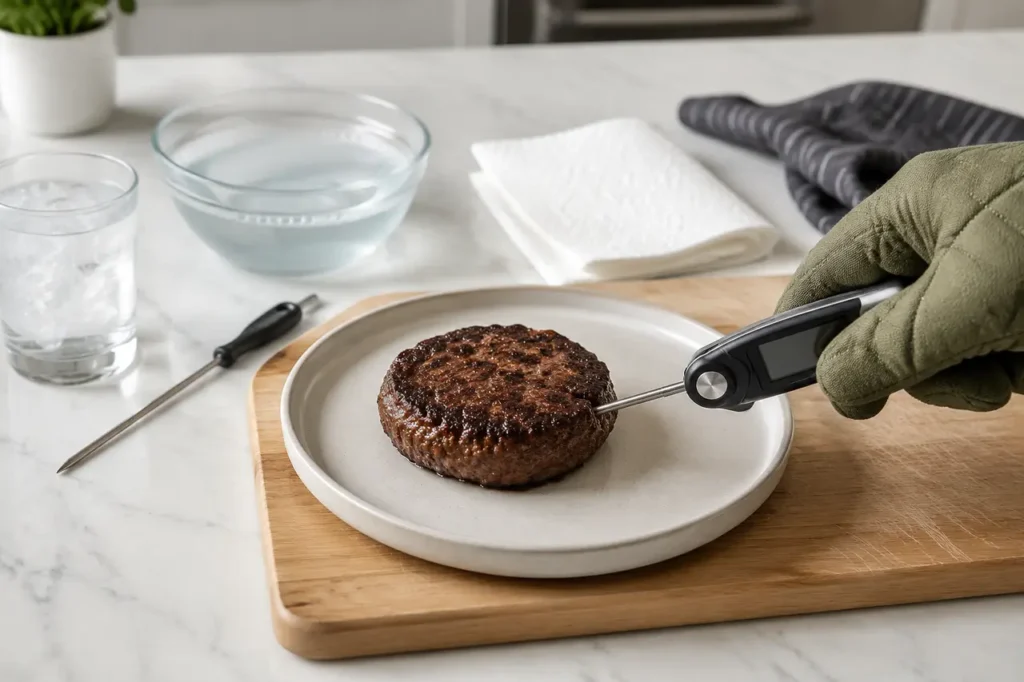
The number is useful only when the sensing area reaches the part that must be checked. A thin thermocouple tip can read close to its end; other probes may sense across a longer section. Read the manual, find the thickest area, insert without touching bone, fat pockets, gristle, pan, or grate, and move slowly enough to identify the coolest relevant center. For thin food, USDA advises entering from the side. Check several spots rather than treating one warm edge as the whole item.
Separate safe minimums from preferred doneness
USDA’s current chart lists 165°F for all poultry and for leftovers and casseroles; 160°F for ground meats; and 145°F plus a three-minute rest for intact beef, pork, veal, and lamb steaks, chops, and roasts. Fish is listed at 145°F. Follow the current chart and any recipe or local rule that sets a higher target. A thermometer supports the decision; color, juices, timing, and touch are not reliable substitutes for the specified internal temperature.
Wait for stability instead of racing a headline
A response claim describes manufacturer conditions, not permission to glance at the first changing digit. Insert into the correct place, watch the trend, and wait until the value settles enough for the decision. A hold button should capture that stable center reading after placement, not freeze a transient value while the probe passes through a hot crust. When checking several pieces, repeat the placement for each because food thickness and heat exposure vary across a pan or grill.
Prevent cross-contamination between checks
A probe that touched raw poultry or meat should not move into cooked food without the cleaning or sanitizing step required by the manual and food-safety guidance. Keep a clean zone for the thermometer body, avoid laying the contaminated probe on a counter, and wash hands or change gloves after handling raw food. Water-resistance ratings differ and do not authorize soaking every body or hinge. Clean the metal probe promptly, keep fluid out of unapproved openings, and dry before folding.
Verify accuracy without hiding damage
A properly made crushed-ice bath can provide a 32°F reference at ordinary pressure when the probe is placed in the slush without touching the glass. Follow the model’s official accuracy-test and calibration procedure, including immersion depth and stabilization time. Calibration adjusts a permitted offset; it does not straighten a bent probe, remove corrosion, restore a failing battery contact, or seal a cracked body. Recheck after a hard drop or unexpected reading and retire a physically damaged thermometer.
OXO Thermocouple: best for probe handling and angle choice
Choose the OXO Good Grips Thermocouple Thermometer when easy probe handling and readable angles matter as much as the raw sensor specification. OXO lists a 225-degree rotating probe, an automatic screen rotation, backlight, and a rotating dial that opens the probe without making the user pull on a food-soiled metal stem. Its thermocouple tip is designed to sense near the end, so it does not need the long immersion depth associated with many thicker dial thermometers. OXO publishes a two-to-three-second response and ±0.9°F accuracy under its stated conditions.
The handling design is useful at a crowded stovetop. Open the probe before approaching the heat, grip only the body, insert the tip into the thickest relevant center without touching bone, gristle, a pan, or a grill grate, and wait for the value to settle. For a thin burger, chop, or chicken breast, USDA advises inserting from the side so the sensing area reaches the middle. Check more than one point because thickness and heat exposure vary. Remove the probe before returning food to the oven or grill; this is not a leave-in thermometer.
OXO lists an IP66 body, a range from -58°F to 572°F, degree or tenth-degree display options, and AAA power. Those features support cooking, candy, oil, and beverage checks within the exact manual’s limits, but a broad range does not make every use equally safe. Keep the plastic body away from flame and hot cookware, do not exceed the stated temperature or exposure instructions, wash the probe between foods, and dry the hinge and body before folding. Replace a damaged probe, cracked housing, or corroded battery compartment rather than trying to calibrate around physical damage.
Who should avoid it: skip it if the larger folding body will not fit the storage plan, a replaceable fine-tip probe is required, the exact cleaning method will not be followed, or the thermometer may be left inside an oven or grill.
Javelin PRO Classic: best large display and hold control
Choose the Lavatools Javelin PRO Classic when a large display and a hold function make hot or awkward checks easier. Lavatools specifies a two-inch backlit antifog display with automatic rotation, a 4.5-inch probe, motion-activated wake and backlight, a magnetic back, and a control that holds a stabilized reading and beeps. The maker lists a typical two-to-three-second response, ±0.9°F accuracy across a stated core range, and an overall range from -40°F to 482°F. These are published specifications, not Hamejur test results.
The hold control is useful only after the probe reaches the food’s center and the reading settles. Insert correctly first, activate the function according to the manual, then move the display away from steam or heat to read it. Do not press hold on the way through the crust or edge and treat that transient value as the center temperature. Check separate thick areas in poultry and large roasts. When a recipe gives a doneness preference lower than a USDA safety minimum, food-safety guidance and any required rest time take priority.
Lavatools lists IP65 splash resistance rather than submersion, a CR2032 battery, a fold-away probe, and a storage magnet. Keep it away from flame, hot oven walls, and prolonged heat, and do not store it on an appliance surface that becomes hot. Clean the metal probe after every contact and disinfect as the manual allows when moving from raw to cooked food. The current product page is titled PRO Classic but still contains legacy PRO Duo wording in several paragraphs; use the model identity and specifications panel, not old naming alone, when matching a replacement or listing.
Who should avoid it: choose another thermometer if splash resistance will be mistaken for submersion, a button-cell battery is undesirable, the storage surface becomes hot, the hold control will be used before reaching the center, or legacy naming makes the exact listing unclear.
TempPro TP19H: best straightforward core feature set
Choose the TempPro TP19H when the household wants the familiar folding-probe formula with hold, calibration, motion wake, and an auto-rotating backlit display. The current manufacturer page lists a four-inch stainless probe, NTC sensor, 180-degree display rotation, magnetic back, hanging hole, IP65 rating, and one AAA battery. It also lists a temperature range from -58°F to 572°F and accuracy of ±0.9°F under the stated conditions. The maker currently claims a one-second response; Hamejur treats that as a published claim and still recommends waiting for a stable value.
The TP19H can be simple to share because there is no app or remote receiver to configure. Open the probe, let the display wake, insert the sensing end into the center, and use hold only after the value stops moving meaningfully. For a whole bird, check the innermost thigh and wing area and the thickest breast while avoiding bone, following current USDA placement guidance. For ground meat, casseroles, reheated leftovers, fish, and intact cuts, use the applicable safe-minimum category rather than color, firmness, or clear juices.
TempPro’s current page includes a brand note saying ThermoPro is now TempPro and that either branding may appear on packaging. The exact Amazon identity likewise references that transition. That is not automatically a mismatch, but confirm TP19H, the probe layout, included battery, and manual before use. Calibration can correct an allowed offset after a properly prepared reference check; it cannot repair a bent probe, water inside the body, a weak connection, or contamination. Rinse only as the exact IP65 instructions allow, dry promptly, and store the folded probe away from hot metal.
Who should avoid it: skip it if the brand transition will create receiving confusion, a thermocouple sensor is required, a button-cell-free design is not enough to offset the smaller display, or users may treat calibration as a fix for physical damage.
Match the thermometer to the cooking check
You work around several awkward pan and grill angles
Start with OXO Thermocouple. Its dial-open rotating probe and auto-rotating display reduce handling friction while the tip still must reach the center.
You want a larger display and a stable-reading hold
Start with Javelin PRO Classic. Let the value settle in the food before using hold, and treat IP65 as splash resistance rather than submersion.
You want a familiar folding tool with AAA power
Start with TempPro TP19H. Confirm the TP19H identity across the ThermoPro-to-TempPro branding change and follow its calibration instructions.
Avoid these instant-read thermometer mistakes
Do not measure only the surface or hot edge. Reach the thickest relevant center and check more than one location.
Do not let the probe touch bone, cookware, or the grill grate. Contact can misrepresent the food’s internal temperature.
Do not press hold while the value is still changing. Stabilize first, then capture the reading if the model supports it.
Do not move a raw-food probe into cooked food without cleaning it. Keep the probe and hands from transferring contamination.
Do not leave a folding instant-read tool in the oven. Remove it after the spot check unless the exact model is specifically designed for continuous heat.
Frequently asked questions
Where should I insert an instant-read thermometer?
Into the thickest relevant part, avoiding bone, fat, gristle, cookware, and the heat source. For thin foods, USDA advises inserting through the side until the sensing area reaches the center. Check several areas in large or irregular food and follow the model’s required insertion depth.
What internal temperature makes chicken safe?
USDA’s current safe-minimum chart lists 165°F for all poultry, including ground poultry. For a whole bird, its placement guidance calls for checking the innermost thigh and wing and the thickest breast without touching bone. Consult the current chart because official guidance can change.
Is a one-second thermometer automatically better?
No. Response time is useful when checking many items, but placement, sensing area, stable display behavior, cleaning, visibility, accuracy tolerance, and durability matter. A fast wrong-location reading is still wrong. Treat response as a published condition and wait until the value stabilizes.
Can I wash the whole thermometer under running water?
Only to the extent the exact manual and water rating permit. OXO lists IP66, while Lavatools and TempPro list IP65 for these models. Those codes are not all the same and do not mean prolonged soaking, dishwasher use, or safe cleaning with the battery compartment open.
How do I test a cooking thermometer in ice water?
Use the maker’s procedure. A common method packs a glass with crushed ice, adds enough clean water to fill the gaps, stirs, and places the sensing area in the center without touching the glass. Wait for stability and compare with the allowed tolerance before using any calibration control.
Can I leave an instant-read thermometer in the oven?
Not unless the exact product is explicitly rated as an oven-safe leave-in thermometer. Folding handheld probes are generally used for spot checks and removed. Heat can damage the body, display, hinge, seals, and battery even when the metal probe itself covers a broad measurement range.
The bottom line
OXO Thermocouple is the handling-first choice, Javelin PRO Classic is the large-display-and-hold choice, and TempPro TP19H is the straightforward core-feature choice. Correct placement, a stable reading, food-safe cleaning, and the current USDA temperature chart matter more than any speed headline. For related kitchen decisions, read Hamejur’s vacuum-sealer guide, immersion-blender guide, or browse Food Preparation.
OXO Good Grips Thermocouple Thermometer
For fast checks with an easy-opening probe and rotating display
Lavatools Javelin PRO Classic
For a large rotating display and stabilized-reading hold function
TempPro TempSwift PLUS TP19H
For the main folding-probe features with AAA power
Sources and method
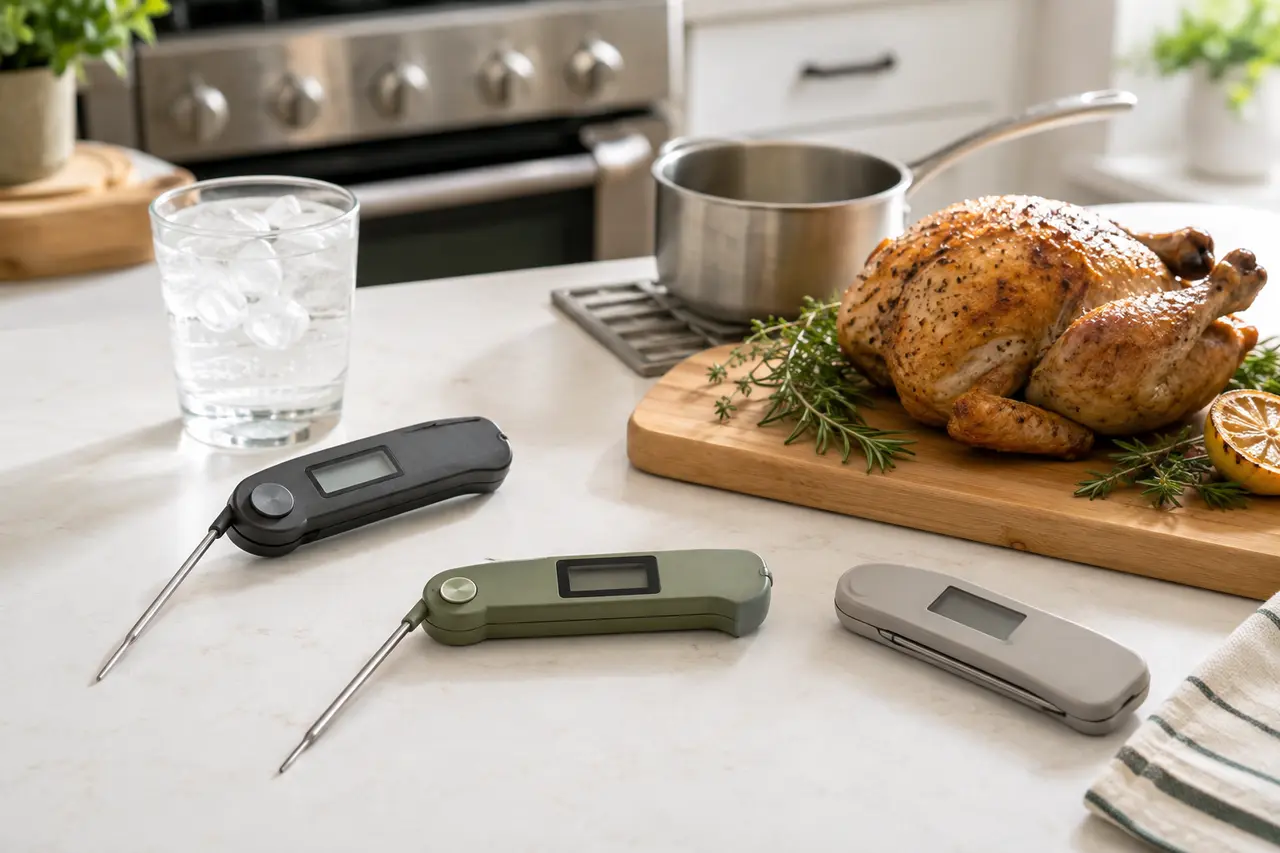
Hamejur compared current U.S. product identity, sensor and sensing-tip description, published response and accuracy, probe length and rotation, display behavior, hold, calibration, water rating, battery, storage, cleaning, brand transitions, USDA placement guidance, and Amazon identity on September 3, 2026. Hamejur did not physically test these thermometers or food. Contextual images use generic probes. Manufacturer performance figures remain attributed, and USDA guidance controls the safety discussion.
Read How We Compare for Hamejur’s evidence, selection, and disclosure standards.
Primary sources: OXO Good Grips Thermocouple Thermometer page; OXO thermometer use article; Lavatools Javelin PRO Classic product and specification page; Lavatools thermometer accuracy-test guide; TempPro TP19H product and specification page; TempPro instant-read thermometer collection; USDA safe minimum internal temperature chart; USDA food thermometer placement guidance.