As an Amazon Associate I earn from qualifying purchases. Hamejur's conclusions remain editorially independent.
Comfort & air · Moisture-control guide
Short answer: the right dehumidifiers for basements depend on how the water leaves the room. Pick the Midea Cube MAD35S1QWT for a large bucket and downward gravity drain, the Frigidaire FHDD3534Y1 for a conventional 35-pint smart unit, and the Honeywell TPFIT50PWK when a built-in pump must lift condensate to a sink. Measure humidity and fix leaks first; no portable appliance substitutes for source control.
Disclosure: As an Amazon Associate I earn from qualifying purchases. Hamejur does not receive payment for choosing one model over another. Prices, availability, colors, package contents, and specifications can change, so confirm the exact model before ordering.
Quick verdict
Best large-bucket gravity pick: Midea Cube MAD35S1QWT. A nestable cube body, app control, wheels, and included drain hose suit a drain below the unit, but Midea’s current capacity page conflicts.
Best conventional smart pick: Frigidaire FHDD3534Y1. A narrow 35-pint body, three fan speeds, low-temperature specification, and app control fit a typical laundry route with a separate gravity hose.
Best built-in-pump pick: Honeywell TPFIT50PWK. A 50-pint current-standard rating and included pump tube can reach an elevated sink, with more height, weight, sound, and power to plan around.
The three picks at a glance
LARGE-BUCKET SMART PICK
Midea Cube MAD35S1QWT
A lift-and-twist body, large removable bucket, wheels, app and voice control, and included gravity-drain hose suit a floor drain below the outlet.
Watch for: Midea’s current page conflicts by calling this model both 20 and 35 pints and pairing it with two room-size figures. Confirm the MAD35S1QWT label; do not buy from coverage copy alone.
CONVENTIONAL SMART PICK
Frigidaire FHDD3534Y1
A conventional narrow body, 35-pint published capacity, three fan speeds, continuous-drain option, Wi-Fi control, and 41°F minimum operating temperature fit a typical laundry area.
Watch for: the drain hose is sold separately and there is no built-in pump. App access does not replace a continuously descending hose or regular bucket, filter, and coil checks.
BUILT-IN-PUMP PICK
Honeywell TPFIT50PWK
A 50-pint current-standard rating, built-in pump, included drain tube, large 14-pint tank, Laundry mode, Auto-Comfort mode, and castered body suit an elevated sink.
Watch for: the larger 40.48-pound body and published 51-decibel sound need a planned location. Pump height, tube routing, temperature, cleaning, and condensate destination still require inspection.
How Dehumidifiers for Basements Compare
| Decision factor | Midea Cube MAD35S1QWT | Frigidaire FHDD3534Y1 | Honeywell TPFIT50PWK |
|---|---|---|---|
| Published current capacity | Exact spec says 35 pints; page conflicts | 35 pints/day | 50 pints/day |
| Water removal | Large bucket or included gravity hose | Bucket or separate gravity hose | 14-pint bucket, gravity option, or built-in pump |
| Can water travel upward? | No built-in pump listed | No built-in pump listed | Yes; published pump route up to 15 ft |
| Remote control | SmartHome app and voice | App, Alexa, and Google | Local controls; no Wi-Fi listed |
| Published minimum temperature | Confirm exact manual | 41°F | 41°F |
| Approximate published size | 14.45 D × 14.76 W × 14.57 H in | 11.1 D × 14.7 W × 19.8 H in | 10.55 D × 15.35 W × 24.1 H in |
| Main ownership issue | Capacity-page conflict and broad bucket | Supply and slope the drain hose | Secure and maintain the pump route |
Capacity is pints of water removed per day under a defined test condition, not a tank-size figure or a guarantee for every room. Temperature, starting humidity, air movement, leakage, and moisture source change actual removal.
Choose dehumidifiers for basements by moisture source and drainage
Measure humidity and find the water source
The EPA recommends keeping indoor relative humidity around 30 to 50 percent. Use a separate hygrometer away from the appliance outlet, wet wall, and dryer exhaust. Record readings over several days and after rain, laundry, showers, or temperature changes. Look for plumbing leaks, foundation seepage, damp crawl spaces, exterior drainage problems, condensation on cold pipes, and an improperly vented dryer. Repairing or isolating the source comes before asking a portable unit to collect the result.
Compare capacity under the current test standard
ENERGY STAR explains that dehumidifier capacity is the number of pints removed in 24 hours under specified temperature and humidity conditions. DOE test conditions changed in 2019 to 65°F, so an older 70-pint label can correspond to a current 50-pint class rather than a stronger machine. Compare current-standard figures when possible, then size for the area and how wet it is. Do not use square-foot marketing as the only input.
Choose bucket, gravity, or pump drainage first
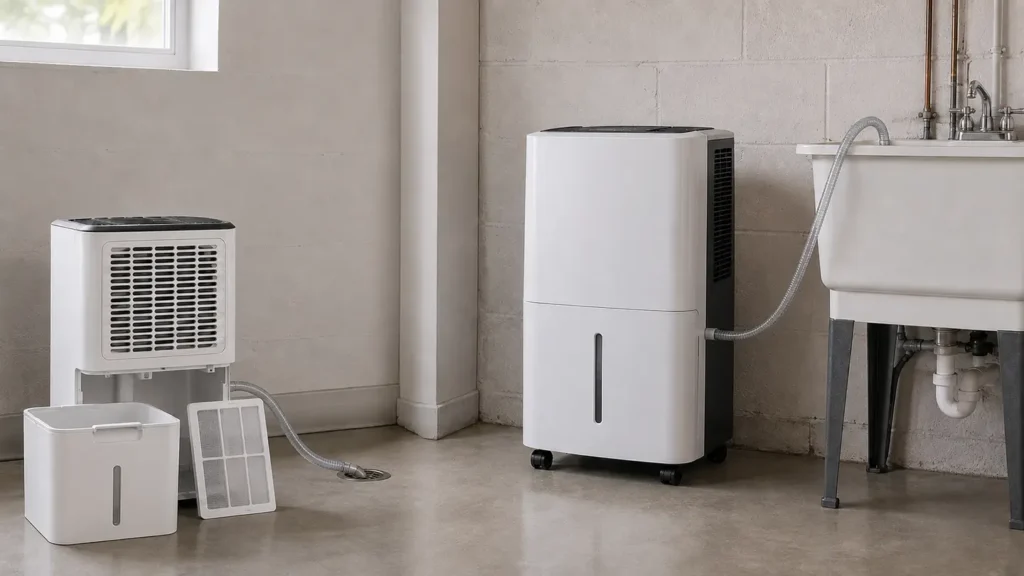
A bucket works anywhere the unit can stand safely, but collection stops when it fills and every trip carries several pounds of water. Gravity drainage reduces carrying only when the hose falls continuously to a lower drain. A built-in pump can lift condensate to a sink, yet it adds tubing, connections, cleaning, and failure points. Sketch the real route, measure elevation and length, protect the hose from feet and doors, and test for leaks before unattended operation.
Respect temperature and airflow limits
A refrigerated-coil dehumidifier removes less water in a cool room and may enter defrost behavior as the coil approaches freezing. Stay within the exact operating range and give the inlet and outlet their required clearance. Do not wedge the unit between laundry, a wall, and a shelf. Keep doors and windows positioned according to the moisture-control plan. If a basement remains very cold, ask whether heating, insulation, ventilation, or a different dehumidification method is more suitable.
Plan filter, bucket, and drain care
Unplug before removing the filter or cleaning the bucket. Vacuum or wash the filter only as the manual permits, dry it fully, and reinstall it in the correct direction. Wash residue from the bucket, float, drain fitting, and accessible hose so biofilm and mineral deposits do not build up. Inspect gravity hoses for a rising loop and pump tubes for kinks or loose ends. Keep the coil, fan, cord, control panel, and plug dry.
Midea Cube MAD35S1QWT: best for a large bucket and gravity drain
Choose the Midea Cube MAD35S1QWT when a large bucket and collapsible storage form solve more problems than a conventional narrow cabinet. Midea’s exact model specification identifies 35 pints per day, SmartHome app and voice compatibility, wheels, an included drain hose, and a lift-and-twist design in which the upper unit nests into the bucket for storage. In operating form, the larger reservoir can reduce trips to a sink. In continuous-drain form, the included hose can route water to a drain that sits reliably below the outlet.
The official page needs an explicit warning: its title and one marketing section describe a 20-pint unit for 1,500 square feet, while the exact MAD35S1QWT model block and specification area identify 35 pints and 3,500 square feet. Those statements cannot all describe capacity under one method. This guide treats the exact model specification as the stronger identity clue and does not use either coverage number as a buying promise. Confirm the label on the offer, carton, appliance, and current support document before relying on capacity.
Midea publishes a 14.45-inch depth, 14.76-inch width, 14.57-inch height, and a weight of 39.62 pounds. Measure the nested storage spot and the full operating height, and remember that a large bucket becomes heavy when full. The model does not list a built-in pump, so continuous drainage depends on gravity: the hose must descend without a rise, pinch, sag pocket, or submerged end. App control can report and change settings, but it cannot correct a blocked hose, full bucket, dirty filter, cold coil, or water source.
Who should avoid it: skip it if the conflicting capacity page cannot be resolved for the exact offer, the drain is above the unit, lifting or cleaning a large bucket is difficult, the broad cube footprint blocks airflow, or app setup adds no value.
Frigidaire FHDD3534Y1: best conventional smart dehumidifier
Choose the Frigidaire FHDD3534Y1 when a familiar upright cabinet and current 35-pint specification fit the room better than a wide cube or a larger pump model. Frigidaire publishes Wi-Fi control through its app, Alexa and Google voice support, three fan speeds, continuous drainage, and a minimum operating temperature of 41°F. The body is listed at about 19.8 inches high, 14.7 inches wide, 11.1 inches deep, and 37 pounds, which is narrower than the Midea Cube but taller in normal use.
A 41°F minimum does not mean a cold basement will always remove water at its rated pace. Dehumidification capacity is tested at defined conditions, while real output falls as temperature and humidity change. Watch for frost, frequent defrost behavior, long run times, and limited collection. Address drafts or heating conditions if the room sits near the limit, and do not operate below the manual’s range. The model can help manage moisture in the air; it cannot repair seepage, condensation from an uninsulated surface, or a leaking laundry connection.
Frigidaire supports continuous gravity drainage, but the required garden hose is not included. Choose a short hose that fits the specified connection, route it steadily downward, and test for leaks before leaving the unit unattended. There is no built-in pump to raise water to a sink. Wi-Fi is useful for remote status and control only when the appliance remains safely positioned and connected. Clean the filter at the prompted interval, inspect the bucket and drain fitting, and leave the air inlet and outlet clear.
Who should avoid it: choose another model if water must travel upward, a drain hose cannot slope continuously, the room routinely falls below the supported temperature, Wi-Fi is unwanted, or the tall cabinet interferes with shelves and airflow.
Honeywell TPFIT50PWK: best built-in-pump dehumidifier
Choose the Honeywell TPFIT50PWK when the available drain is a utility sink above the floor and a built-in pump is the deciding feature. Honeywell lists 50 pints per day under the current DOE standard and 70 pints under the older standard, a pump tube that can move condensate up to 15 feet vertically or horizontally, a 14-pint tank, 185-cubic-feet-per-minute airflow, Laundry mode, and Auto-Comfort mode. The included pump route distinguishes it from the gravity-only Midea and Frigidaire selections.
A pump solves elevation, not neglect. Secure the tube so it cannot jump from the sink, kink behind the unit, or create a trip path. Confirm the manual’s maximum lift and run, test the pump with supervision, inspect every connection, and make sure the destination can accept the flow. Keep a floor plan for what happens if power fails or a fitting loosens. The bucket, float, and pump area still need cleaning even when the owner rarely carries water by hand.
Honeywell publishes dimensions of 15.35 by 10.55 by 24.1 inches, a weight of 40.48 pounds, 710 watts, 51 decibels, and an operating range of 41°F to 90°F. Those figures make this the tallest and highest-capacity selection here, with a stronger claim on floor, acoustic, and electrical planning. The model does not list Wi-Fi, which can be a benefit for local-control households. Laundry mode may suit a drying room, but wet clothes still require ventilation and the moisture source must not overwhelm the space.
Who should avoid it: skip it if an elevated drain is unnecessary, the tall 40-pound body is hard to position, a 51-decibel published figure is unsuitable for the room, the circuit or outlet is questionable, or the pump tube cannot be secured and inspected.
Match the dehumidifier to the room’s drain route
A floor drain sits below a broad open area
Start with the Midea Cube MAD35S1QWT. Its large bucket and included gravity hose fit a downward route after the capacity identity is confirmed.
A narrow laundry spot needs smart status
Start with the Frigidaire FHDD3534Y1. Its conventional cabinet and current 35-pint specification fit a separately supplied gravity hose.
The only practical drain is an elevated sink
Start with the Honeywell TPFIT50PWK. The built-in pump is the reason to accept its taller, heavier, higher-power form.
Avoid these basement-dehumidifier mistakes
Do not use a dehumidifier to ignore a leak. Stop water entry, repair plumbing, and correct exterior or ventilation problems first.
Do not route a gravity hose uphill. A rise, kink, sag pocket, or submerged outlet can stop drainage and fill the bucket.
Do not compare old and current pint labels directly. Check the DOE test basis before deciding one unit removes more water.
Do not block the inlet or outlet with laundry. Maintain the clearances in the exact manual and keep fabrics away from the unit.
Do not trust app status without inspecting the room. Check the hose, bucket, filter, floor, humidity, temperature, and moisture source in person.
Frequently asked questions
What humidity should a basement have?
The EPA recommends keeping indoor relative humidity around 30 to 50 percent. A basement near the high end may need source control and dehumidification, while an extremely low target can waste energy and dry materials. Use an independent hygrometer and watch for condensation or odor. If you also need CO2, particulate, VOC, or radon trends, see Hamejur’s indoor air-quality monitor guide; those sensors answer different questions from a dehumidifier’s built-in humidity reading.
What does a 35-pint dehumidifier rating mean?
It means the manufacturer reports removal of 35 pints of water in 24 hours under a defined test condition. It is not the bucket capacity and does not mean every basement will yield that amount. Temperature, humidity, airflow, and the water source affect collection.
When do I need a built-in pump?
A pump is useful when condensate must travel upward to a utility sink or another approved destination. A floor drain below the unit can usually use gravity. Stay within the pump height and length limits, secure the tube, and inspect the route even during automatic operation.
Why does the Midea MAD35S1QWT page show two capacities?
Midea’s current page title and marketing copy say 20 pints, while the exact model block and specification section say 35 pints. This guide does not reconcile that conflict by assumption or use its room-coverage claims. Confirm the model label and current documentation before ordering.
Will a dehumidifier remove basement mold?
Lower humidity can make future growth less favorable, but an appliance does not remove existing contamination or fix the moisture source. Address leaks and damp materials promptly. For significant, recurring, sewage-related, or health-sensitive contamination, follow EPA guidance and seek qualified remediation advice.
The bottom line
Midea Cube MAD35S1QWT is the large-bucket gravity choice, Frigidaire FHDD3534Y1 is the conventional 35-pint smart choice, and Honeywell TPFIT50PWK is the built-in-pump choice. Start with the water source, current-standard capacity, and real drain elevation before comparing convenience features. For nearby air decisions, read Hamejur’s humidifier guide, smart air purifier guide, or browse Home Comfort.
Midea Cube MAD35S1QWT
For a large bucket, nestable body, and downward gravity drain
Frigidaire FHDD3534Y1
For a narrow 35-pint smart unit with a gravity-drain option
Honeywell TPFIT50PWK
For higher-capacity removal and a drain above floor level
Sources and method
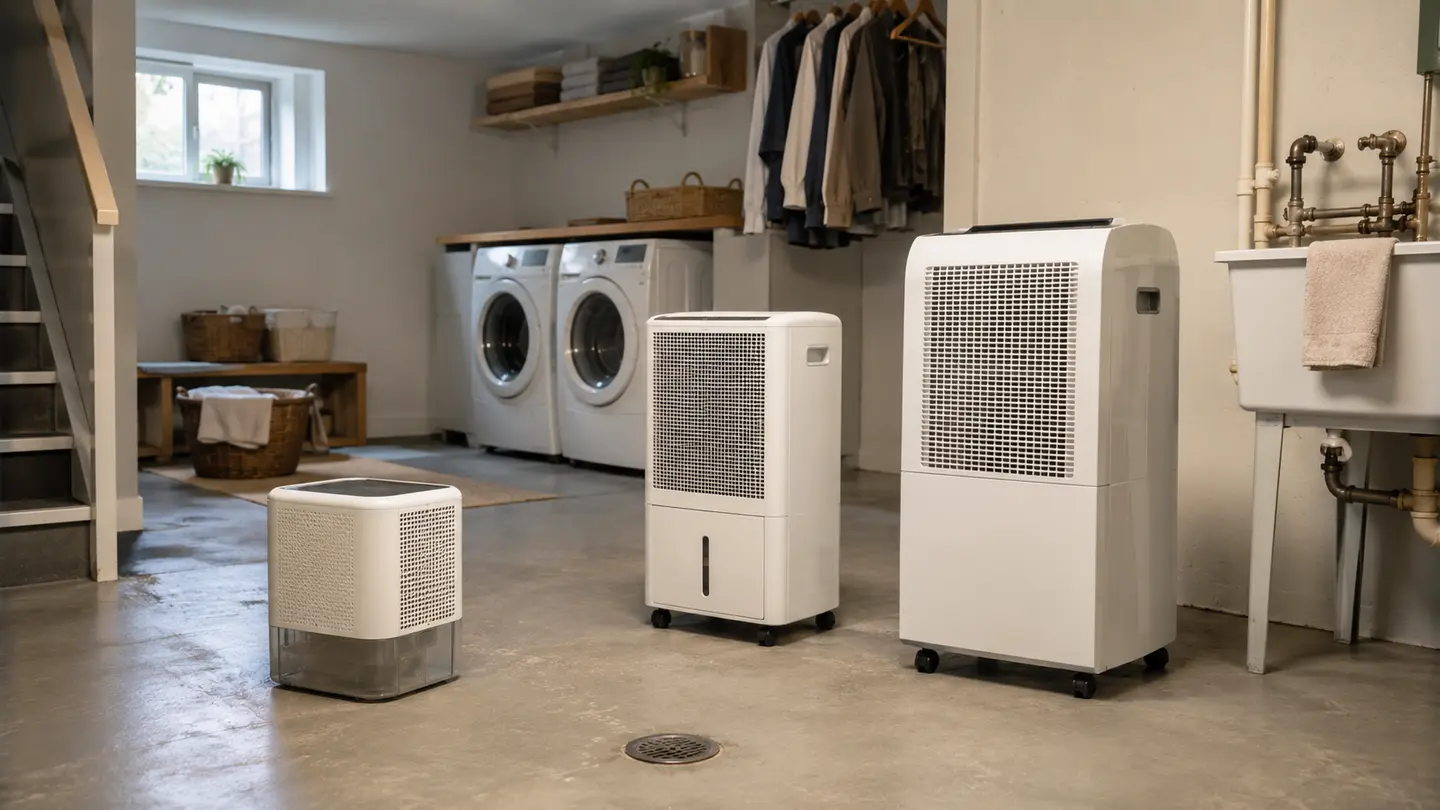
Hamejur compared exact U.S. model identity, current-standard pint capacity, bucket design, gravity and pump drainage, control method, published temperature range, size, weight, sound, electrical input, filter care, and EPA and ENERGY STAR moisture guidance on September 2, 2026. Hamejur did not physically test these units. Contextual images show generic dehumidifier forms and separate drainage methods rather than the named products. Midea’s conflicting capacity and room statements remain visible as uncertainty.
Read How We Compare for Hamejur’s evidence, selection, and disclosure standards.
Primary sources: Midea Cube MAD35S1QWT official page; Frigidaire FHDD3534Y1 official page; Honeywell TPFIT50PWK official page; ENERGY STAR dehumidifier capacity guide; ENERGY STAR dehumidifier buyer guidance; U.S. EPA Care for Your Air guide; U.S. EPA moisture-control guidance.


