As an Amazon Associate I earn from qualifying purchases. Hamejur's conclusions remain editorially independent.
Simple DIY & tools · Buyer guide
Short answer: the best laser distance measurers depend on what happens after one wall is measured. Choose the Bosch GLM100-23 for simple indoor point-to-point readings, the Klein Tools 93LDM100C when an IP54 body, continuous mode, and two-reading memory help around active home projects, and the Leica DISTO D2 when area, volume, an automatic endpiece, ten-reading memory, and Bluetooth reduce notebook work. A longer range does not correct a poor target, tilted tool, or wrong reference point.
Disclosure: As an Amazon Associate I earn from qualifying purchases. Hamejur does not receive payment for choosing one product over another. Prices, availability, accessories, app support, and specifications can change, so confirm the exact U.S. model before ordering.
Quick verdict
Best simple indoor pick: Bosch GLM100-23. Bosch publishes a 100-foot range, typical accuracy of plus or minus 1/16 inch, two-button operation, measurement rounding, and a 0.19-pound body powered by two AAA batteries. It is intentionally narrow in scope.
Best job-ready compact pick: Klein Tools 93LDM100C. Klein lists measurements from 2 inches to 100 feet, single and continuous modes, selectable front or rear reference, memory for the last two readings, reverse-contrast display, and an IP54 rating.
Best planning and app pick: Leica DISTO D2. Leica publishes a range up to 100 meters under ISO 16331-1, ten-reading memory, area and volume functions, a multifunction endpiece with automatic reference detection, IP54 protection, and Bluetooth for DISTO Plan.
The three picks at a glance
SIMPLE INDOOR PICK
Bosch GLM100-23
A 100-foot published range, typical ±1/16-inch accuracy, two buttons, rounding, and a very light body fit quick room and furniture checks.
Watch for: Bosch lists no connectivity and no IP rating. Its strength is a direct reading, not saved layouts, area calculations, or rough-site protection.
JOB-READY COMPACT PICK
Klein Tools 93LDM100C
Single and continuous measurement, two-reading memory, front/rear reference selection, reverse LCD, and IP54 protection suit active household projects.
Watch for: published accuracy changes by distance: ±1/16 inch in the shorter band and ±1/8 inch out to 100 feet. It does not add an app or area workflow.
PLANNING AND APP PICK
Leica DISTO D2
Longer published range, ten-reading memory, area and volume functions, automatic endpiece reference, IP54 protection, and Bluetooth suit multi-room planning.
Watch for: more functions mean more reference and app choices to verify. Do not confuse the established D2 with newer Leica D2G variants or their specifications.
How Laser Distance Measurers Compare
| Decision factor | Bosch GLM100-23 | Klein 93LDM100C | Leica DISTO D2 |
|---|---|---|---|
| Published range | Up to 100 ft | 2 in to 100 ft | Up to 100 m under ISO 16331-1 |
| Published accuracy | Typically ±1/16 in | ±1/16 in shorter; ±1/8 in to 100 ft | Specified by Leica under ISO conditions |
| Reference choices | Basic body reference workflow | Front or rear selectable | Multifunction endpiece with automatic offset |
| Memory | Current reading workflow | Last 2 readings | Last 10 readings |
| Calculations | Measurement and rounding | Single and continuous distance | Area, volume, painter and indirect functions |
| Connection | None | None | Bluetooth to supported app |
| Protection | No IP rating listed | IP54 | IP54 |
Published range and accuracy depend on stated test conditions. Bright light, a dark or reflective target, an oblique angle, movement, temperature, and a weak return signal can reduce usable range or repeatability. For fit-critical work, take repeat readings and verify against the project’s allowed tolerance.
Buy for the measurement chain, not maximum range
One hundred feet already covers most interior rooms
Bosch and Klein both publish 100-foot reach, which exceeds the longest wall in many homes. Leica’s 100-meter specification is more relevant to larger spaces, outdoor lines, or a workflow that also values its endpiece, memory, calculations, and app. A large headline range can be unusable when the laser dot is hard to see or the target returns too little light. Define the largest real line you expect to measure before paying attention to the maximum.
The reference point changes the answer
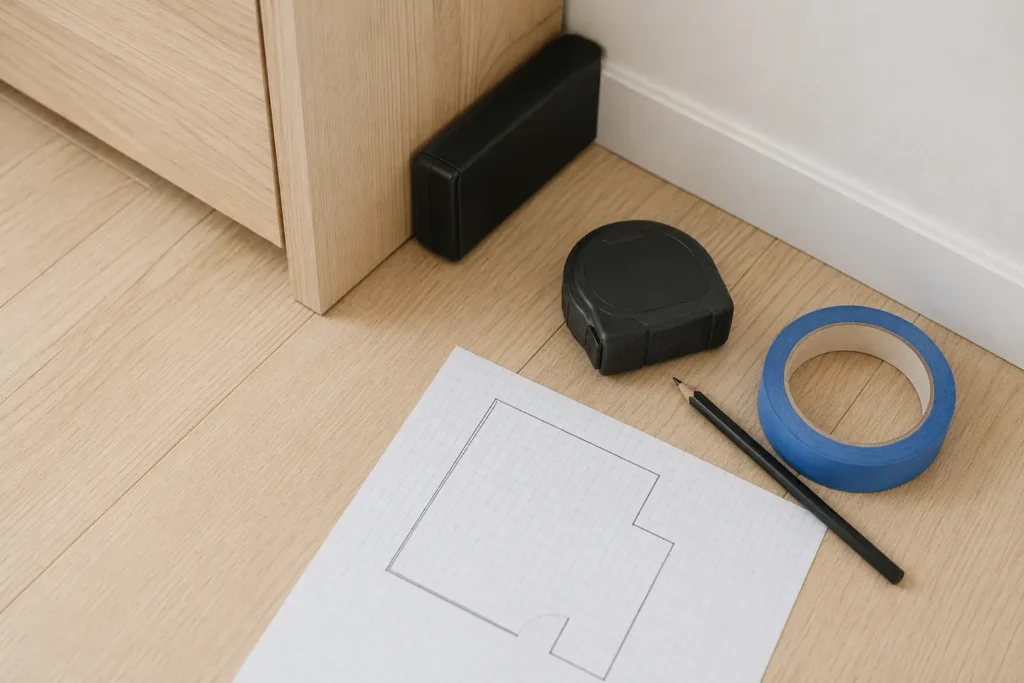
A laser measure normally reports from a defined point on its body, often the rear when the tool is placed against a wall. Measuring from the front instead changes the result by roughly the tool length. Klein lets the user select front or rear reference. Leica’s multifunction endpiece can extend into a corner or catch an edge and automatically adjust the reference. Whichever model you use, confirm the reference icon before writing down a number.
Memory prevents transcription, not planning errors
Two saved readings can hold width and height long enough to compare a cabinet opening. Ten readings help when moving around a room. Bluetooth can transfer values into a supported plan or photo. None of those features knows whether you measured finished wall to finished wall, trim to trim, or the rough opening a product guide requires. Name each dimension, use the same units, and record the measurement boundary with the number.
Area and volume functions are convenience calculators
A device can multiply two readings for floor area or three for volume. That reduces arithmetic and copying, but it does not account for alcoves, islands, sloped ceilings, doors, waste allowance, or the coverage method on a material label. Leica’s painter function can help combine wall areas, yet paint quantity still depends on coats, surface, product coverage, and exclusions. Keep the raw dimensions so the calculation can be checked later.
IP54 is useful protection, not permission to neglect the tool
Klein and Leica list IP54 protection, indicating limited dust ingress and splash resistance under the rating conditions. It does not make either device waterproof or drop-proof. Bosch does not list an IP rating for the GLM100-23. Keep every model dry, protect the optical window, store it away from grit, and remove batteries for long storage if the manual recommends it.
Laser safety should stay automatic
These are measuring tools, not pointers. Follow the exact Class 2 labeling and manual, never aim the beam at eyes or people, and do not look into the source or use optical aids to view it. Keep children from operating the device, and avoid aiming toward traffic, aircraft, or reflective situations that could redirect the beam. Turn it off when measurement is complete.
Bosch GLM100-23: best simple indoor pick
Choose the GLM100-23 when the recurring job is a direct indoor distance and extra menus would slow it down. Bosch publishes a 100-foot range, typical accuracy of plus or minus 1/16 inch, two-button operation, a rounding function, and a weight of 0.19 pound with two AAA batteries. It has no listed connectivity, which keeps the measurement local and immediate.
The rounding function is practical for quick planning when a fractional display needs to be expressed at a chosen precision. Keep the unrounded value when the project has a tight fit. A sofa clearance or rug plan can tolerate a different margin than a built-in cabinet, door, or fabricated part. The device provides a reading; the project determines the acceptable tolerance and required verification.
Bosch does not list an IP rating for this model, so its best setting is a reasonably clean home, apartment, or finished room. Protect the lens and display in a drawer or case and check the reference point every time the tool changes orientation. Simplicity helps only when the measurement habit is consistent.
Who should avoid it: choose a different model if you need splash/dust rating, saved readings, area or volume calculations, app transfer, or a documented corner endpiece.
Klein Tools 93LDM100C: best job-ready compact pick
Choose the 93LDM100C when measurements move between rooms, floors, and active work areas but an app is unnecessary. Klein lists a 2-inch to 100-foot span, single and continuous modes, a reverse-contrast display, memory for the last two readings, front or rear reference selection, two AAA batteries, and an IP54-rated body weighing about 2.3 ounces.
Continuous mode is useful for sliding a target or tool until a desired clearance appears, such as centering furniture or checking a run of shelving. The last-two memory can hold a pair of room dimensions without a phone in hand. Reference selection is equally important: front measurement can help at an edge, while rear measurement is natural when the body is seated against a wall.
Klein publishes different accuracy bands. It states plus or minus 1/16 inch through roughly the first 30 to 33 feet and plus or minus 1/8 inch from there to 100 feet. That is more honest than treating one number as universal. Repeat fit-critical readings from a stable surface and verify with another method when the cost of an error is high.
Who should avoid it: skip it if you need automatic area or volume math, ten-value memory, Bluetooth plan transfer, or substantially more than 100 feet of published range.
Leica DISTO D2: best planning and app pick
Choose the DISTO D2 when a project includes many rooms, corners, areas, or transferred dimensions rather than isolated wall checks. Leica publishes measurement up to 100 meters under ISO 16331-1, storage for the last ten results, area and volume functions, a painter function, an intelligent endpiece, Bluetooth, and IP54 protection. Its FAQ lists two AAA batteries.
The endpiece is the key hardware difference. It can extend for an outside edge or open for a corner, and the device detects the offset so the reading uses the intended reference. That is useful for deep shelves, diagonal lines, and tight corners where a flat tool body cannot sit naturally. The operator still needs to confirm the endpiece is fully positioned and the reference indication matches the setup.
Bluetooth can send dimensions to Leica’s supported DISTO Plan workflow, reducing manual entry on a sketch or photo. App compatibility, permissions, export choices, and subscription terms can change, so verify the current mobile requirements before making it central to a job. This article covers the established DISTO D2; newer D2G variants have different specifications and should not be mixed into the listing identity.
Who should avoid it: choose a simpler model if you only need occasional straight distances and would not use the endpiece, calculations, memory, or app connection.
Match the measure to the project
Furniture and room clearances
Start with Bosch. A light two-button tool is enough when one direct distance is the recurring need.
Shelves, flooring, and active DIY
Start with Klein. Continuous mode, two-value memory, selectable reference, and IP54 protection support a moving project.
Multi-room plans and estimates
Start with Leica. Endpiece offsets, calculations, ten readings, and Bluetooth reduce repeated notebook entry.
Six checks before you order
1. Define the longest real line. Measure whether the job is a 20-foot room, a 60-foot basement, or a larger exterior span. Do not buy range that cannot be used at the target.
2. Write down the required boundary. Finished wall, trim edge, cabinet opening, and rough framing are different dimensions.
3. Check reference control. Decide whether rear, front, corner, and extended-edge measurements are necessary.
4. Set an error budget. Compare published accuracy with the clearance, cut tolerance, and verification method for the project.
5. Choose the recording method. One display, two-value memory, ten-value memory, and app transfer support different levels of planning.
6. Protect the beam and lens. Plan safe aim, stable placement, storage, clean optics, and battery care before the first measurement.
Frequently asked questions
Is a 100-foot laser measure enough for a house?
It is enough for most interior room dimensions and many basement or garage checks. Exterior work can be harder before the geometric distance reaches 100 feet because daylight and target reflectivity reduce dot visibility and signal return. Buy longer range only when the actual lines, target conditions, and workflow justify it.
Are laser measures more accurate than tape measures?
They avoid tape sag and make one-person room measurements easier, but they introduce their own errors: reference choice, tilt, movement, target angle, beam spot, and environmental conditions. A tape can be better for short edges and direct part marking. Use the tool that matches the geometry and verify important dimensions with a second reading or method.
Can I measure a wall area automatically?
A model with an area function can multiply length by height. The Leica D2 includes area and painter-oriented functions; the Bosch and Klein models here focus on distance workflows. Automatic math still needs a plan for doors, windows, multiple wall sections, waste, and product coverage. Save the original dimensions.
What does IP54 mean for a laser measure?
It indicates a tested level of protection from dust ingress and splashing water, not waterproofing or impact resistance. Klein and Leica list IP54; Bosch does not publish an IP rating for this model. Keep all three out of rain, standing water, abrasive debris, and unprotected tool piles.
Can I use a laser measure around children or pets?
Keep the device under adult control and never aim at people, animals, eyes, reflective hazards, vehicles, or aircraft. Follow the Class 2 labeling and the manufacturer’s manual. A moving pet or child can cross the beam unexpectedly, so clear the line before measuring and turn the device off immediately afterward.
The bottom line
Bosch GLM100-23 is the simple indoor choice, Klein 93LDM100C is the compact job-ready choice, and Leica DISTO D2 is the planning and app choice. Select by reference point, recording method, and real project tolerance before maximum range. For locating framing before measuring a mounting layout, compare our stud finder guide. Find more homeowner tool guidance in Hamejur’sSimple DIY & Tools section.
Bosch GLM100-23
For simple indoor point-to-point readings
Klein Tools 93LDM100C
For compact project use and two-value memory
Leica DISTO D2
For corners, calculations, memory, and app transfer
Sources and method
Hamejur compared exact U.S. model identity, published range and accuracy, reference control, memory, calculations, connection, power, environmental rating, and safety role on August 28, 2026. Manufacturer specifications are not represented as Hamejur field tests. Contextual images illustrate measurement setup rather than exact tools.
Read How We Compare for Hamejur’s evidence, selection, and disclosure standards.
Primary product sources: Bosch GLM100-23 official page; Klein Tools 93LDM100C official page; Leica DISTO D2 official page.