As an Amazon Associate I earn from qualifying purchases. Hamejur's conclusions remain editorially independent.
Kitchen & food · Compact appliance guide
Short answer: the best rice cookers for small households depend on how much variety belongs in the weekly routine. Choose the Zojirushi NS-LGC05 for small batches across several rice and grain programs, the Tiger JNP-S55U-KY for one-button white rice, and the Aroma ARC-914SBD when two or three people will use a larger cooked yield, digital programs, and a steam tray. Capacity labels are not standardized, so compare uncooked rice-cup capacity, cooked yield, and the supplied measuring cup separately.
Disclosure: As an Amazon Associate I earn from qualifying purchases. Hamejur does not receive payment for choosing one model over another. Prices, availability, colors, package contents, and specifications can change, so confirm the exact model before ordering.
Quick verdict
Best for menu control: Zojirushi NS-LGC05. Its 3-cup Micom system covers several rice types, porridge, and steel-cut oatmeal in a small body, with more parts and decisions than a one-switch model.
Best for simple white rice: Tiger JNP-S55U-KY. A single cooking control, compact depth, retractable cord, and 12-hour keep-warm claim suit a focused routine.
Best for a small family: Aroma ARC-914SBD. An 8-cup cooked yield, dedicated rice programs, steam tray, and delay control add flexibility, with more food-safety and cleaning attention.
The three picks at a glance
MENU-CONTROL PICK
Zojirushi NS-LGC05
A 3-rice-cup Micom cooker with white, brown, long-grain, mixed, sushi, quick, porridge, and steel-cut-oatmeal settings, automatic and extended keep warm, and a retractable cord.
Watch for: the 3-cup label uses the smaller rice-cooker measuring cup, not a standard U.S. cup. Its menu depth, longer body, and nonstick inner pan make sense only when varied grains will be cooked.
ONE-BUTTON PICK
Tiger JNP-S55U-KY
A 3-rice-cup heating-plate cooker with one-button white-rice operation, automatic keep warm for up to 12 hours, a retractable cord, and detachable inner lid and steam gaskets.
Watch for: it has one plain-rice program, not separate brown-rice or porridge logic. The linked KY suffix is black, while Tiger’s official family page may illustrate another color suffix.
SMALL-FAMILY PICK
Aroma ARC-914SBD
An 8-cup-cooked digital multicooker with White Rice, Brown Rice, Steam, and Flash Rice programs, automatic keep warm, delay timer, and a steam tray for small-family meals.
Watch for: its 8-cup label describes cooked yield; Amazon also identifies 4 cups uncooked. Delayed cooking is not suitable for leaving raw meat or other perishable ingredients warm for hours.
How Rice Cookers for Small Households Compare
| Decision factor | Zojirushi NS-LGC05 | Tiger JNP-S55U-KY | Aroma ARC-914SBD |
|---|---|---|---|
| Published capacity | Up to 3 rice cups / 0.54 L | 3 rice cups / 0.54 L | 2 to 8 cups cooked; 4 cups uncooked listing |
| Control style | Micom digital menus | One physical rice switch | Digital rice, steam, and faster-rice programs |
| Best routine | Several rice types and oatmeal | Plain white rice | Rice plus steaming for two or three |
| Keep warm | Automatic and extended modes | Automatic up to 12 hours | Automatic after cycle |
| Counter footprint | About 9.1 W × 11.9 D in | About 9.1 W × 8.7 D in | About 8.5 W × 8.6 L in |
| Main ownership check | Program choice and removable lid parts | One-menu limit and gasket reassembly | Capacity language, perishables, and steam parts |
A rice-cooker cup is normally 180 milliliters, not a 240-milliliter U.S. measuring cup. Follow the supplied cup, inner-pan marks, exact model manual, and grain-specific instructions.
Choose rice cookers for small households by actual batch size
Translate every capacity label
A 3-cup Zojirushi or Tiger refers to dry rice measured with the smaller rice cup, while Aroma markets the ARC-914SBD by an 8-cup cooked yield and identifies a 4-cup uncooked limit. Those figures are not interchangeable. Estimate the dry rice used for an ordinary meal, the amount of leftovers the household actually wants, and the model’s minimum batch. Buying too large can make a thin small batch less forgiving; buying too small can force back-to-back cycles.
Choose menu logic only when the grain changes
Micom and digital programs can alter soaking and heating for white, brown, long-grain, mixed rice, or oatmeal. A one-button heating-plate cooker is easier when the household uses one white-rice routine and values a familiar physical control. Neither design corrects a wrong measuring cup, mismatched water line, or the wrong menu. List the grains cooked during a normal month and pay for the controls that will be selected, not the largest button panel.
Measure lid and steam clearance
Counter dimensions describe the closed body. The cooker also needs space for the lid to open, room for a hand to lift the inner pot, a dry path to the outlet, and overhead clearance so steam does not soak a cabinet. Do not place the vent under a shelf edge, near loose paper, or where a child can reach the plume. Keep the cord away from the sink and counter edge, and move the appliance only after it is unplugged and cool.
Treat keep warm as a timed function
Keep warm is useful for serving over a reasonable period under the exact manual, not for forgetting rice indefinitely. Note when the cycle ended, stir or fluff as directed, and follow the manufacturer’s time limit. USDA advises refrigerating perishable leftovers within two hours at normal room temperature and using cooked leftovers within three to four days. Divide extra rice into shallow containers for prompt cooling rather than leaving a deep warm pot on the counter.
Count every part that touches steam or food
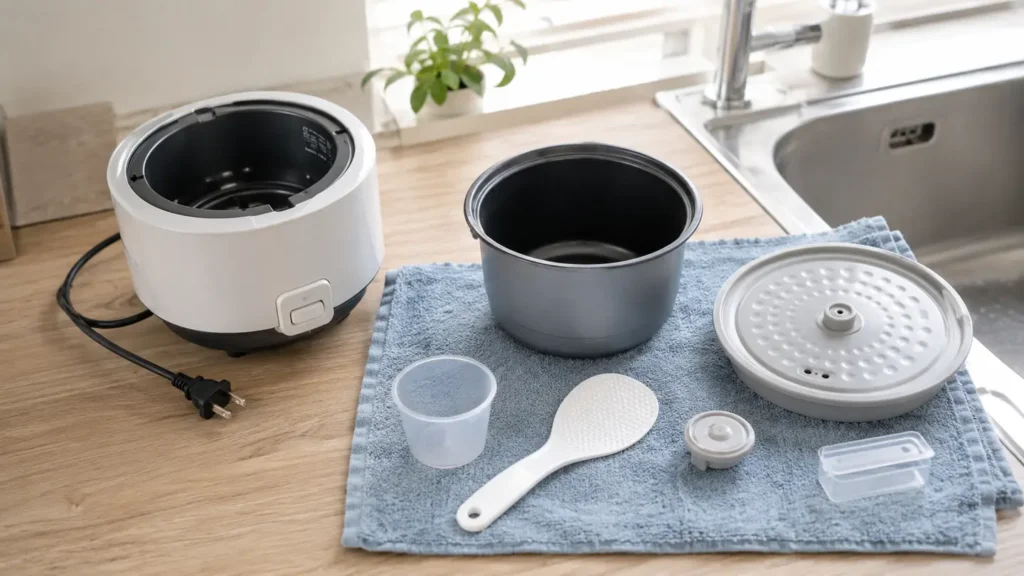
A small body can still have an inner lid, steam vent, gasket, condensation collector, tray, cup, and paddle. Let the cooker cool, unplug it, remove only approved parts, and wash them by the method in the manual. Wipe the base without letting water reach electrical components. Dry the outside of the inner pan and every removable part before reassembly. A simple model may be easier to own because it has fewer modes, but neglected steam residue can affect any cooker.
Zojirushi NS-LGC05: best for varied rice and grain programs
Choose the Zojirushi NS-LGC05 when a small household regularly switches among white, brown, long-grain, mixed, sushi rice, porridge, and steel-cut oatmeal and will use dedicated menu logic. This 120-volt Micom cooker is rated for up to 3 rice cups, or 0.54 liter, and Zojirushi says it can cook as little as half a cup. The microcomputer changes soaking, heating, and resting around the selected program rather than relying on one mechanical switch. That makes the NS-LGC05 the control-first choice, not automatically the best choice for someone who cooks only one pot of plain white rice each week.
The published footprint is about 9 1/8 inches wide, 11 7/8 inches deep, and 7 1/2 inches high, with a 450-watt electrical rating. Measure depth with the lid open and leave the steam path clear of cabinets, walls, and anything that can be damaged by moisture. The retractable cord helps storage, while a carrying handle makes relocation easier only after the cooker is cool and unplugged. Automatic and extended keep-warm functions, reheating, a detachable inner lid, and a removable steam vent support repeat use, but each removable part still needs the cleaning sequence in the exact manual.
Use the supplied 180-milliliter rice cup and the matching inner-pan line for the selected grain; a household measuring cup changes the ratio. Rinse and drain only as the rice and manual direct, seat the dry outside of the pan against a clean heating area, and choose the correct menu rather than trying to correct a wrong water line with a different program. Protect the nonstick surface with approved utensils and replace a deeply damaged pan. This model earns its extra controls when the owner accepts the menu step and the parts-cleaning routine.
Who should avoid it: skip it if the household cooks only plain white rice and wants one switch, needs a shallower appliance, prefers an uncoated cooking vessel, or is unlikely to select programs and wash the detachable lid and vent after use.
Tiger JNP-S55U-KY: best for simple white-rice batches
Choose the Tiger JNP-S55U-KY when the recurring job is a small batch of plain white rice and one physical switch is preferable to a digital menu. Tiger’s JNP-S55U uses a heating plate, a 0.54-liter capacity, and a single plain-rice setting. Push the control after measuring rice and water correctly; the cooker changes to keep warm at the end. The company specifies automatic keep warm for up to 12 hours. That simplicity reduces setup choices, but it also means there is no dedicated brown-rice, oatmeal, mixed-grain, or quick program to manage a different cooking curve.
Tiger lists the 3-cup model at roughly 9.1 inches wide, 8.7 inches deep, and 8.8 inches high, about 4.6 pounds, 120 volts, and 305 watts. Its short depth can be easier on a compact counter than the longer Zojirushi body. A retractable cord helps when the cooled cooker returns to a cabinet. The black KY Amazon model and Tiger’s current JNP-S55U family documentation share the core size and function, but confirm the suffix, voltage, included rice cup, spatula, manual, and finish on the offer received.
The aluminum inner pot uses a fluorine coating, so use the supplied or another approved non-scratching utensil. Tiger makes the inner lid and steam gaskets detachable for cleaning. Let the unit cool, unplug it, remove only the parts named in the manual, and dry them completely before reassembly. Check that every gasket returns in the right orientation; a misplaced seal can affect steam handling. One-button operation is not permission to guess ratios or leave old rice indefinitely. Use the supplied rice cup, follow the water markings, and stay within the manual’s keep-warm guidance.
Who should avoid it: choose another cooker if brown rice, oatmeal, delayed starts, steaming, or several menu programs are routine; if a coated aluminum pan is unwanted; or if the owner will not remove and reinstall the lid gaskets correctly.
Aroma ARC-914SBD: best for a small family and steam tray
Choose the Aroma ARC-914SBD when two or three people need more cooked yield than a 3-cup machine and will use brown-rice, steaming, or faster-rice programs. Aroma describes this model as an 8-cup-cooked, 2-quart digital rice and grain multicooker that prepares 2 to 8 cups of cooked rice. The current Amazon identity also states 4 cups uncooked and 8 cups cooked. White Rice, Brown Rice, Steam, and Flash Rice controls, automatic keep warm, a delay timer, and the included steam tray make it the most flexible meal-oriented option here without moving to a large pressure multicooker.
Aroma lists dimensions of about 9.3 inches high, 8.6 inches long, and 8.5 inches wide, a weight of 4.9 pounds, and a 120-volt, 60-hertz, 350-watt rating. The compact footprint still needs overhead clearance for steam and lid opening. The tray can cook compatible food above rice, but timing, thickness, food load, and safe doneness must follow the manual; a rice cycle is not a universal meat-timing program. Aroma specifically cautions against leaving raw meat on a delayed start for more than two hours. For any perishable ingredient, use current food-safety guidance and avoid a room-temperature wait.
The current Aroma page describes a ceramic-coated nonstick pot, while older retail descriptions may use broader nonstick language. Confirm the exact pan and manual in the package instead of assuming a coating from a reused listing title. Use the included rice cup because Aroma explains that it is 180 milliliters, smaller than a 240-milliliter U.S. cup. Let the cooker cool before cleaning, remove the pan, inner lid, steam parts, and condensation collector only as directed, keep water out of the electrical base, and dry everything before assembly. The extra functions remain useful only when those parts are cleaned after multi-ingredient meals.
Who should avoid it: skip it if the smallest half-cup batch matters most, a one-switch cooker is preferred, steaming above rice will not be used, delayed-start limits are inconvenient, or the buyer cannot confirm the current inner-pot material and package contents.
Match the cooker to the weekly routine
One or two people rotate rice and oatmeal
Start with Zojirushi NS-LGC05. The half-cup-to-3-cup range and dedicated menus make the controls useful rather than decorative.
Plain white rice is the only recurring job
Start with Tiger JNP-S55U-KY. One switch and a compact depth remove menu decisions while keeping the batch small.
Two or three people want rice and vegetables
Start with Aroma ARC-914SBD. The larger cooked yield and steam tray support a simple meal, with timing and cleaning under the manual.
Avoid these small rice-cooker mistakes
Do not compare cup labels without reading whether they mean dry or cooked rice. Use the supplied 180-milliliter cup.
Do not guess the water ratio across grains. Match the rice, menu, cup, and inner-pan line in the exact manual.
Do not vent steam into a cabinet or toward a hand. Leave clear space above and around the outlet.
Do not put raw perishable food on a long delay. Follow the model instructions and current food-safety guidance.
Do not wash the electrical base or reassemble wet parts. Unplug, cool, clean removable pieces, and dry fully.
Frequently asked questions
What does a 3-cup rice cooker mean?
For the Zojirushi and Tiger models here, it means up to three dry rice-cooker cups, each about 180 milliliters, not three standard U.S. cups. Cooked volume is larger and varies by rice type. Use the supplied cup and the matching pan markings.
Which model is best for one person?
Zojirushi’s NS-LGC05 is the strongest fit when very small batches and several grain programs matter; Zojirushi says it can cook as little as half a rice cup. Tiger is simpler for plain white rice. Actual appetite and desired leftovers matter more than the household label.
Can I cook brown rice in a one-button Tiger JNP-S55U?
Tiger lists one computerized menu setting: plain rice. Do not assume a dedicated brown-rice cycle or timing. If brown rice is routine, choose a model whose current manual expressly supports it, such as the Zojirushi or Aroma options, and use that model’s water guidance.
Can I steam food while rice cooks in the Aroma?
The ARC-914SBD includes a steam tray and Aroma describes simultaneous steaming above rice. Use only combinations and quantities covered by the current manual, verify safe doneness for perishable food, and do not use a long delay with raw meat or another ingredient that requires refrigeration.
How long can cooked rice stay on keep warm?
Follow the exact model’s current limit and note when the cycle ended. Tiger publishes up to 12 hours; other modes and models differ. Keep warm is not permanent storage. Refrigerate extra rice promptly under USDA guidance and discard food left at room temperature beyond safe limits.
The bottom line
Zojirushi NS-LGC05 is the varied-menu choice, Tiger JNP-S55U-KY is the one-button white-rice choice, and Aroma ARC-914SBD is the small-family steaming choice. Translate capacity labels, measure steam clearance, and count cleanup parts before paying for more programs. For adjacent kitchen decisions, read Hamejur’s mini food processor guide, gooseneck kettle guide, or browse Kitchen Appliances.
Zojirushi NS-LGC05
For small batches across several rice and grain programs
Tiger JNP-S55U-KY
For straightforward 3-cup white-rice cooking with one switch
Aroma ARC-914SBD
For two or three people who want rice programs and steaming
Sources and method
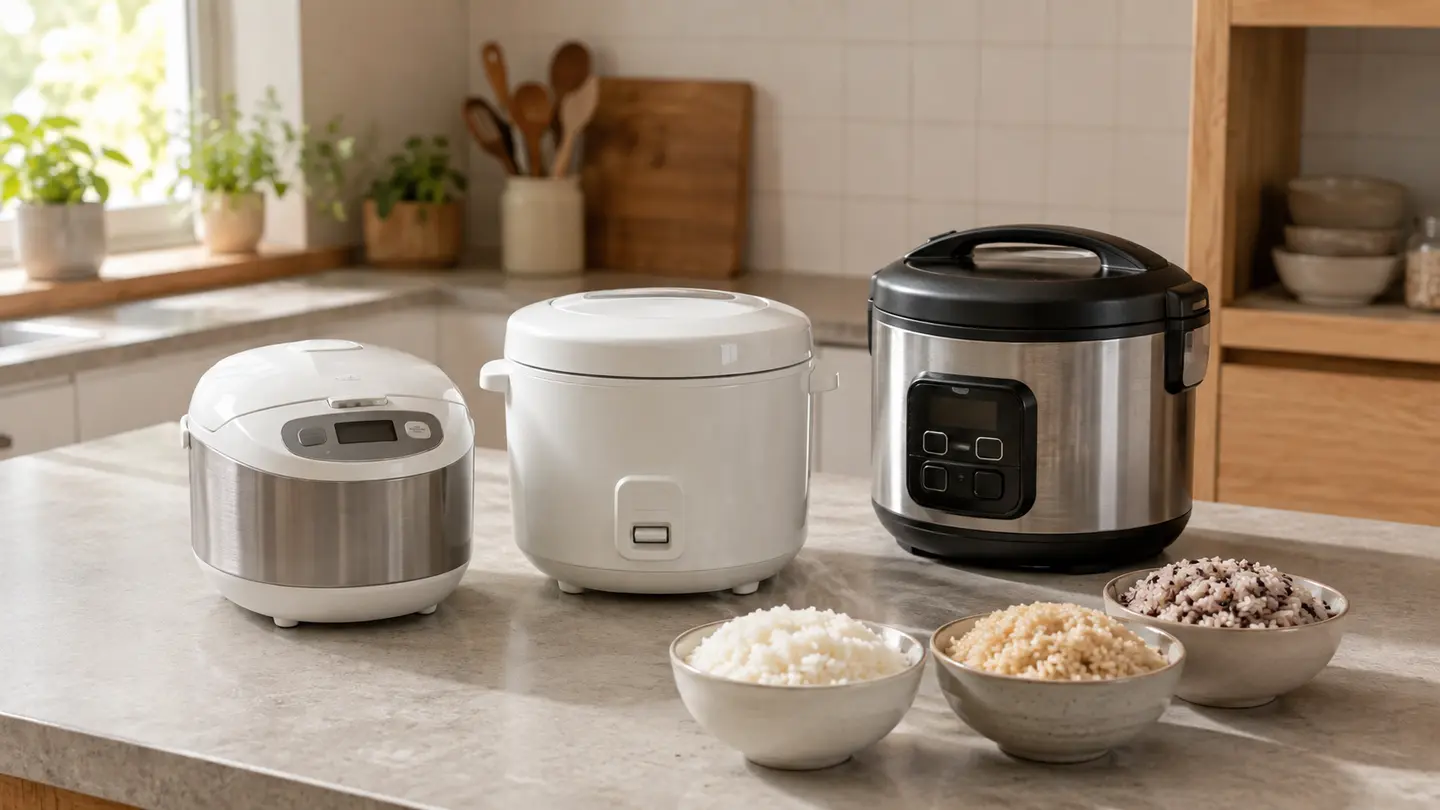
Hamejur compared exact U.S. model identity, dry and cooked capacity language, supplied measuring systems, rice and grain programs, heating method, keep-warm behavior, delay and steaming functions, dimensions, electrical ratings, removable parts, warranty, food-safety guidance, and current Amazon listings on September 2, 2026. Hamejur did not physically test these cookers. Contextual images show generic appliances rather than the named products. Manufacturer cooking and capacity statements remain attributed claims.
Read How We Compare for Hamejur’s evidence, selection, and disclosure standards.
Primary sources: Zojirushi NS-LGC05 official product specifications; Zojirushi NS-LGC05 manuals and support; Tiger JNP-S55U official features and specifications; Aroma ARC-914SBD official product and care page; USDA leftovers and food-safety guidance; USDA cooked-food refrigerator guidance.


