As an Amazon Associate I earn from qualifying purchases. Hamejur's conclusions remain editorially independent.
Smart Home · Buyer guide
Short answer: these two smart garage door controllers are best separated by ecosystem and compatibility, not by a generic “smart” label. Choose the Chamberlain myQ Smart Garage Control MYQ-G0401-ES when you want myQ’s own app workflow and Amazon Key support with a compatible opener. Choose the Meross MSG100HK when Apple Home integration and broader voice-platform support are the priority. Before buying either one, identify the exact garage-door-opener brand/model, confirm functioning safety sensors, and run the manufacturer’s compatibility check; some Chamberlain/LiftMaster/Craftsman systems need an extra Meross accessory.
Disclosure: As an Amazon Associate I earn from qualifying purchases. Hamejur does not receive payment for choosing one product over another. Product specifications and listings can change, so confirm the exact model before ordering.
Quick verdict
Chamberlain myQ Smart Garage Control MYQ-G0401-ES: best for households that want the native myQ workflow and Amazon Key support. Limitation: third-party smart-home choice is narrower than Meross, and opener compatibility must be checked first.
Meross MSG100HK: best for Apple Home users and households that want wider assistant integration. Limitation: compatibility can require an extra accessory on some Chamberlain-group openers.
The two controller picks at a glance
BEST FOR THE MYQ ECOSYSTEM
Chamberlain myQ Smart Garage Control MYQ-G0401-ES
A Wi-Fi/Bluetooth hub and door sensor for many openers made after 1993, with myQ app control, real-time alerts, schedules, guest access, and Amazon Key support.
Watch for: compatibility depends on the existing opener and functioning standard safety sensors; do not assume “after 1993” means every model works
BEST FOR APPLE HOME AND MULTI-PLATFORM CONTROL
Meross MSG100HK
A 2.4 GHz Wi-Fi controller with a wired door sensor, Meross app, Apple Home/Siri support, Alexa and Google control, alerts, auto-close, and local home-network control.
Watch for: Meross says some Chamberlain/LiftMaster/Craftsman openers require an extra accessory, so complete the model-specific compatibility check before ordering
Smart garage door controllers: ecosystem and compatibility
| Decision point | Chamberlain myQ MYQ-G0401-ES | Meross MSG100HK |
|---|---|---|
| Primary ecosystem | myQ app; Amazon Key support | Meross app; Apple Home, Siri, Alexa, Google |
| Wireless | Wi-Fi + Bluetooth setup | 2.4 GHz Wi-Fi |
| Door sensing | Included door sensor | Wired magnetic door sensor |
| Compatibility emphasis | Most major openers after 1993 with standard safety sensors | Compatibility check; some Chamberlain-group openers need accessory |
| Notable automation | Alerts, schedules, guest access | Alerts, auto-close, local home-network control |
| Best fit | myQ / Amazon Key household | Apple Home / multi-platform household |
Compatibility comes before smart-home features
Start with the opener, not the controller. Chamberlain says its Smart Garage Control works with most major openers manufactured after 1993 that use standard safety sensors, but its own page still provides a model/manufacturer compatibility list. Meross requires a compatibility check and explicitly notes that some Chamberlain, LiftMaster, and Craftsman units need an extra accessory.
A useful pre-purchase workflow is: identify the opener model, confirm the existing wall control and safety sensors work normally, check Wi-Fi coverage in the garage, then use the controller manufacturer’s compatibility tool. Do not buy based only on the year printed on the opener.
Door-state sensing is as important as the relay command
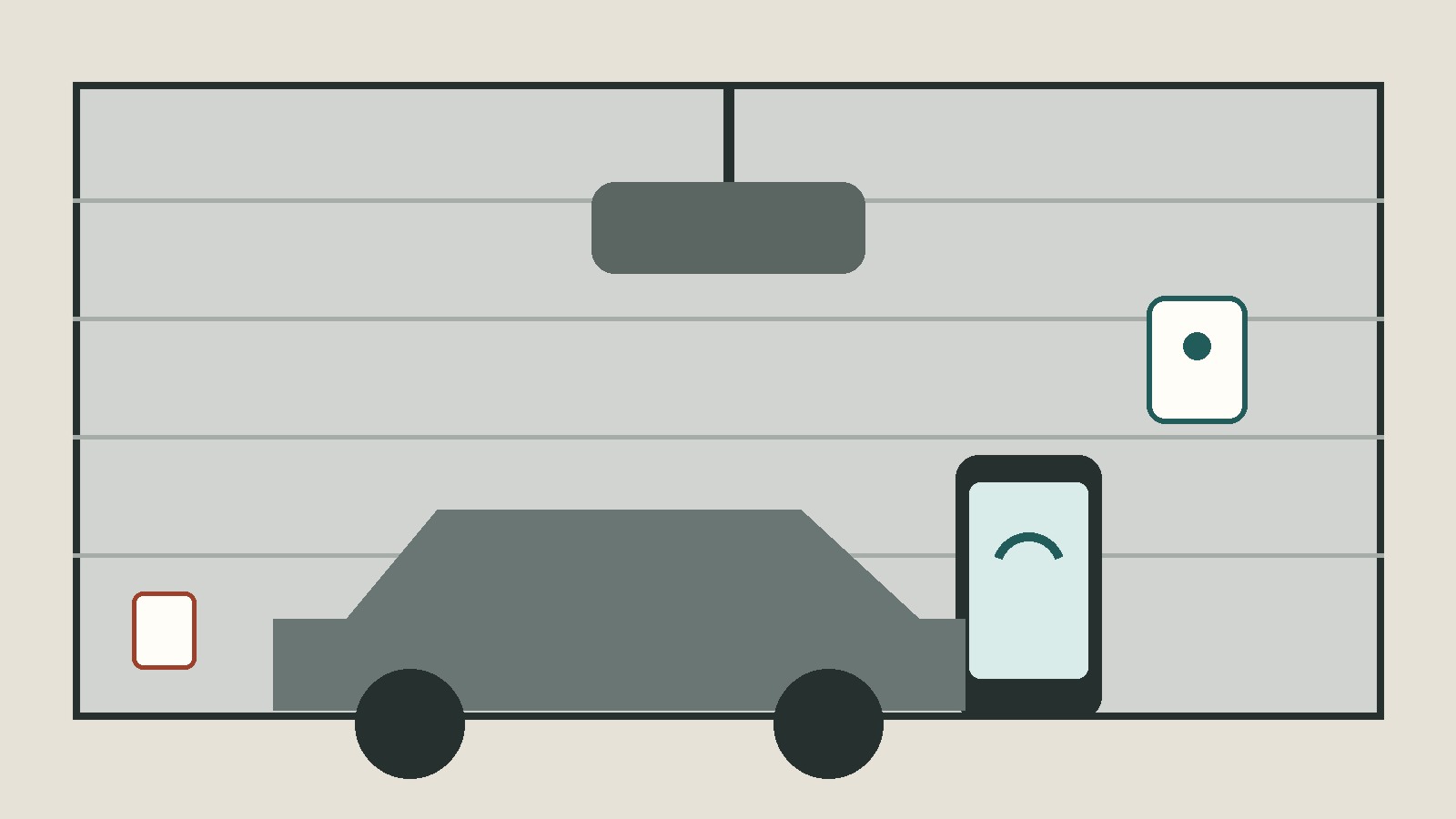
A smart controller does more than imitate a wall-button press; it also needs to know whether the door is open or closed. myQ uses an included door sensor, while the Meross MSG100HK uses a wired sensor. That hardware difference affects placement, battery maintenance, cable routing, and troubleshooting.
When a status notification seems wrong, diagnose the sensor state before assuming the opener itself failed. A controller that can send a command but cannot reliably report door position is not a complete remote-access system.
Decide which ecosystem should own garage access
myQ keeps the experience centered on the myQ application and adds features such as guest access, daily schedules, alerts, and Amazon Key integration. Meross emphasizes Apple Home/Siri plus Alexa and Google compatibility, and its official material describes local control while the phone is on the home network.
Neither approach is universally better. If garage access is a dedicated task, a focused app can be simpler. If the garage door is part of broader scenes and automations, the smart-home ecosystem may matter more.
Chamberlain myQ MYQ-G0401-ES: the myQ-first choice
Choose the MYQ-G0401-ES when the myQ app and Chamberlain’s compatibility path match how you want to manage garage access.
Chamberlain specifies Wi-Fi and Bluetooth connectivity, app-based status/control, real-time alerts, daily schedules, guest access, Amazon Key support, and compatibility with most major garage-door-opener brands manufactured after 1993 when standard photoelectric safety sensors are present.
The appeal is a focused garage-access ecosystem rather than a generic home-automation hub. The included door sensor gives the system independent open/closed state information, while Bluetooth simplifies onboarding. If you already value myQ or in-garage Amazon delivery, those capabilities are more decision-relevant than adding another voice assistant.
Who should avoid it: buyers who specifically want Apple Home integration or broader third-party smart-home control should look at Meross instead.
Bottom line: myQ is the cleaner choice when native garage access and Amazon Key matter more than cross-platform automation.
Meross MSG100HK: the Apple Home choice
Choose the Meross MSG100HK when HomeKit/Siri integration or multi-platform control is a primary requirement.
Meross lists Apple HomeKit/Siri, Amazon Alexa, and Google Assistant support, 2.4 GHz Wi-Fi, a 23-foot wired door sensor, app alerts, auto-close options, and local home-network control. Its official compatibility guidance says some Chamberlain, LiftMaster, and Craftsman openers need an additional accessory.
The wired sensor is simple but affects installation: you need a clean path from the controller to the door-position sensor. In return, the device can expose garage status to the chosen smart-home ecosystem instead of keeping every action inside a garage-specific app. Compatibility is the hard gate; software features are irrelevant if the relay interface does not match your opener.
Who should avoid it: buyers who do not want to route a sensor wire or who prefer myQ/Amazon Key as the center of the garage workflow should choose Chamberlain.
Bottom line: MSG100HK is the better fit when Apple Home and cross-platform smart-home control outweigh the extra compatibility checking.
Choose based on your situation
You use Apple Home: Choose Meross MSG100HK after the compatibility check because HomeKit/Siri support is the defining difference.
You want Amazon Key in-garage delivery: Choose Chamberlain myQ MYQ-G0401-ES, which explicitly supports the service.
Your opener is Chamberlain, LiftMaster, or Craftsman: Check the exact model. myQ may be the simpler native route; Meross can work with many units but may require an extra accessory.
Garage Wi-Fi is weak: Improve coverage before installation. A smart controller cannot make remote access reliable when the network connection is marginal.
Installation, privacy, and ownership
- Confirm the existing garage door, wall control, safety sensors, and auto-reverse behavior work correctly before adding a smart controller.
- Use the manufacturer compatibility checker for the exact opener model rather than relying only on brand or age.
- Verify 2.4 GHz Wi-Fi coverage where the controller will be mounted; setup can fail even when the house has strong Wi-Fi elsewhere.
- Secure the account with a unique password and use available account-security features; garage access is a physical-access function, not a low-stakes smart plug.
- Test open, close, status, alerts, and any auto-close/schedule behavior while physically present before relying on remote operation.

Questions buyers usually ask
Will a smart garage controller work with any opener?
No. Compatibility depends on the opener’s control interface, age, safety-sensor design, and sometimes the wall control. Chamberlain and Meross both publish compatibility guidance. Check the exact opener model before ordering.
Does my garage need 5 GHz Wi-Fi?
No for these two controllers. Meross specifies 2.4 GHz Wi-Fi, while Chamberlain’s setup uses Wi-Fi plus Bluetooth. The important point is reliable supported-band coverage at the installation location.
Can I rely on the app instead of the physical door sensor?
No. Door state is a hardware input. The controller needs a reliable sensor to know whether the door is open or closed; the app is only the interface that reports that state and sends commands.
Which option is better for Apple Home?
Meross MSG100HK. Its official product information lists Apple HomeKit/Siri support. The Chamberlain model is the better fit when myQ and Amazon Key are the desired ecosystem instead.
Should I enable automatic closing immediately?
Test the installation first. Confirm sensor status, obstruction detection, alerts, and normal opener safety behavior while you are present. Only then configure schedules or auto-close features according to the manufacturer instructions and your household routine.
Hamejur’s conclusion
Choose the Meross MSG100HK when Apple Home and broad smart-home integration are central to the decision. Choose the Chamberlain myQ Smart Garage Control MYQ-G0401-ES when you prefer myQ’s garage-specific workflow or want Amazon Key support.
The compatibility check is more important than the feature list. Confirm the opener model and garage Wi-Fi first, then decide which ecosystem should own the access experience. For adjacent entry security decisions, Hamejur’s smart-lock and battery-video-doorbell guides cover the front-door side of the same problem.
Ready to compare the exact listings? Confirm the exact model, fit, and included accessories before ordering.
Sources and Method
Checked October 8, 2026. Hamejur reviewed Chamberlain and Meross official product/compatibility information and public Amazon.com identity records for the exact models. Connectivity, compatibility, alert, automation, and integration statements are manufacturer claims. Hamejur did not install or test either controller and does not use current prices, ratings, or review counts in this comparison.