As an Amazon Associate I earn from qualifying purchases. Hamejur's conclusions remain editorially independent.
Smart home · Buyer guide
Short answer: the best Matter smart plugs are not interchangeable once energy monitoring, network design, and privacy enter the decision. Choose the Tapo P110M when you want clear energy graphs in a familiar Wi-Fi app, Eve Energy when a Thread-based, account-free design fits your Apple or multi-platform home, and the Meross MSS315 when you need several Wi-Fi plugs and want energy history in the Meross app. Matter can make basic control portable across ecosystems, but it does not guarantee that every platform will display the same energy data. Check the exact U.S. load rating, controller requirements, and outlet fit before buying.
Disclosure: As an Amazon Associate I earn from qualifying purchases. Hamejur does not receive payment for choosing one product over another. Availability, bundles, firmware, and specifications can change, so confirm the exact model before ordering.
Quick verdict
Best Wi-Fi default: Tapo P110M. Tapo combines 2.4 GHz Wi-Fi, Matter control, scheduling, power protection, and detailed energy views in its own app. It is the simplest recommendation when Thread is not already part of the home.
Best privacy and Thread pick: Eve Energy. Eve publishes a 15A/1,800W U.S. rating, uses Thread, can strengthen the Thread mesh, and does not require an Eve cloud account. The trade-off is a stricter infrastructure requirement: a compatible Matter controller and Thread border router.
Best multi-room pack: Meross MSS315. The verified U.S. four-pack is useful when several lamps or small appliances need the same setup. It uses 2.4 GHz Wi-Fi and requires IPv6 plus a compatible Matter controller for Matter commissioning.
The three picks at a glance
WI-FI DEFAULT
Tapo P110M
Detailed app energy views, scheduling, and power-protection tools make it the clearest general-purpose choice.
Watch for: the U.S. listing and Tapo’s global page publish different regional load figures; confirm the exact package label.
THREAD & PRIVACY
Eve Energy (Matter)
Thread networking, no Eve cloud account, and a published U.S. 15A rating suit privacy-minded smart homes.
Watch for: you need both a compatible Matter controller and a Thread border router; one device may perform both roles.
MULTI-ROOM PACK
Meross MSS315
A verified four-pack, 2.4 GHz Wi-Fi, and app energy history make it practical for several rooms at once.
Watch for: Matter setup needs a compatible controller, and Meross specifies an IPv6-capable home network.
How Matter Smart Plugs Compare
| Decision factor | Tapo P110M | Eve Energy | Meross MSS315 |
|---|---|---|---|
| Best fit | Detailed Wi-Fi energy tracking | Thread, privacy, and mesh strength | Several rooms from one pack |
| Primary radio | 2.4 GHz Wi-Fi | Thread | 2.4 GHz Wi-Fi |
| Matter infrastructure | Compatible controller for ecosystem control | Controller plus Thread border router | Compatible controller; IPv6 network specified |
| Energy view | Tapo app graphs, estimates, and exports | Eve app and supported platform features | Meross app history and usage data |
| Published U.S. load | 15A on the checked U.S. listing; verify package | 15A / 1,800W at 120V | 15A at 120V |
| Account posture | Tapo account for Tapo app services | No Eve cloud or Eve account required | Meross account for Meross app services |
| Main caution | Regional specification mismatch | Thread infrastructure required | IPv6 and controller checks before setup |
Specifications and product identities were checked for the U.S. market on August 27, 2026. Energy data shown inside a manufacturer app is not the same as guaranteed Matter energy reporting inside every connected ecosystem.
What changes the decision in a real home
Matter does not erase Wi-Fi and Thread differences
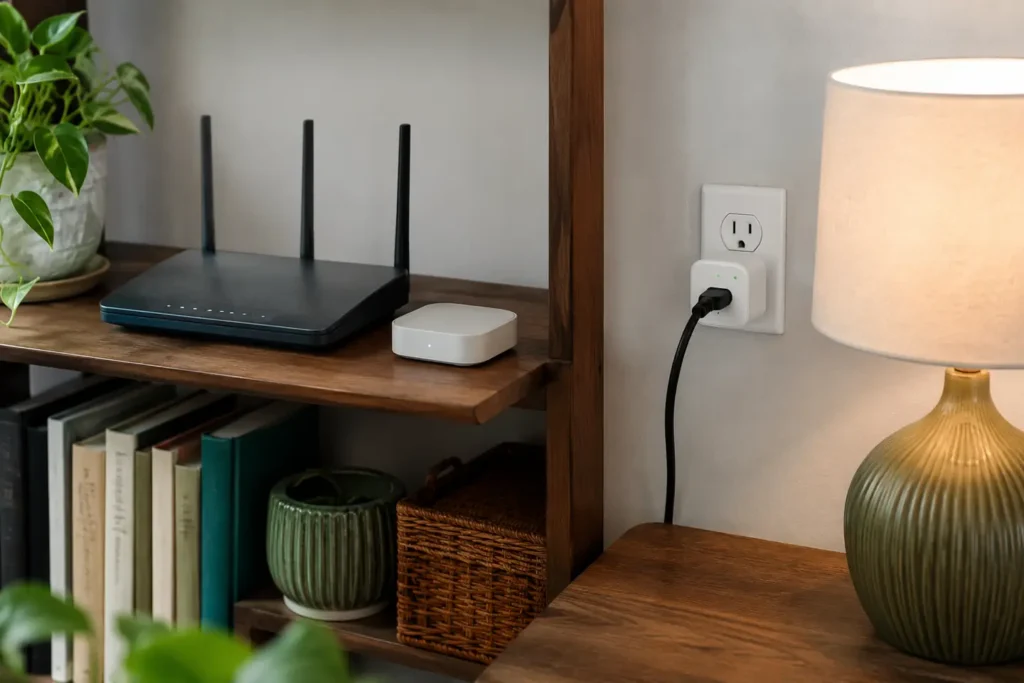
Matter is the application layer that lets compatible ecosystems commission and control a device. The plug still communicates over a network transport. Tapo and Meross use 2.4 GHz Wi-Fi, so each plug joins the home network directly. Eve Energy uses Thread, a low-power mesh protocol, and Eve says the plug can act as a router for nearby Thread accessories. That makes Eve more valuable in a healthy Thread home, but it also means a buyer needs a Thread border router in addition to a Matter controller. Some speakers and hubs provide both functions, but a phone alone is not a permanent home controller.
Energy monitoring has two separate paths
All three picks advertise energy monitoring in their manufacturer apps, yet that does not mean Apple Home, Google Home, Alexa, or another Matter platform will display identical graphs. The Connectivity Standards Alliance added energy reporting to Matter 1.3, but ecosystem support, device firmware, commissioning path, and app design can lag or differ. Buy for the energy view you can verify today. Treat cross-platform energy visibility as a feature to confirm in the exact controller you plan to use, not as an automatic result of seeing the Matter logo.
A load rating is a safety ceiling, not a target
A 15A plug can be suitable for many lamps, fans, and small household devices, but the connected appliance, receptacle, branch circuit, and plug instructions all matter. High-draw heaters, air conditioners, pumps, motors, and appliances with large startup loads need extra caution. Do not use a smart plug as a substitute for the appliance manufacturer’s required control or for a dedicated circuit. Tapo’s checked U.S. Amazon listing identifies the P110M two-pack as 15A, while Tapo’s global P110M page contains 16A regional material. That mismatch is why the package label and U.S. instructions should win over copied comparison charts.
Outlet shape matters in a two-receptacle wall plate
A compact plug can still crowd the second receptacle when its body, cable, or manual switch is oriented poorly. Eve publishes a U.S. body size of about 2.8 by 1.5 by 2.4 inches. Tapo publishes 72 by 51 by 40 millimeters on its global page, while Meross uses a rounded rectangular body. Measure around grounded plugs, power strips, and furniture before ordering a multi-pack. None of these should be daisy-chained through an overloaded adapter.
Tapo P110M: best Wi-Fi default
Choose the Tapo P110M when you want usable energy detail without adding Thread infrastructure. The plug joins 2.4 GHz Wi-Fi and can be added to a Matter controller for broader ecosystem control. Tapo’s product material lists scheduling, remote control, energy monitoring, and power-protection features. Its energy tools can show usage across time periods, estimate bills after a rate is entered, and export data from supported app versions.
The information advantage is the manufacturer app. A buyer who wants to compare a dehumidifier’s weekday use with weekend use, or find a standby load, gets more value from clear graphs and exports than from a generic on/off tile. Power-protection settings can also help stop a connected load after a configured threshold, but they do not replace a circuit breaker or the appliance’s own safety controls.
The main evidence caution is regional identity. The checked U.S. Amazon two-pack is ASIN B0DKGBP38V and presents a 15A U.S. plug. Tapo’s global product page shows regional 16A material. We therefore treat 15A as the listing identity to verify on arrival and avoid moving the global figure into a U.S. recommendation. Firmware and app screens can also change after purchase.
Who should avoid it: skip it if you are building a Thread-first network, want a product with no manufacturer account, or cannot confirm that the connected appliance falls within the exact U.S. instructions.
Eve Energy: best for Thread and account-free control
Choose Eve Energy when privacy, Thread networking, and a clearly published U.S. electrical identity matter more than lowest pack cost. Eve lists the U.S. model at 120V, 60Hz, 15A, and 1,800W. The company also states that no Eve cloud, registration, or Eve account is required. Once commissioned, the plug can route Thread traffic for compatible nearby accessories.
That mesh role creates value beyond the controlled lamp or appliance. A powered Thread router placed between a border router and distant sensors can improve the network path. It is not a guaranteed cure for every weak device, because walls, interference, border-router behavior, and the rest of the mesh still matter. Energy history is available through the Eve app and may surface differently across platforms as their Matter energy support develops.
Infrastructure is the deciding cost. Eve says a hub with both Matter controller and Thread border-router functions is required. A supported Apple TV, HomePod, smart speaker, display, or other hub may cover both, but compatibility must be checked by model and software version. Buyers starting with only a phone should price that hub before comparing the plug itself.
Who should avoid it: choose a Wi-Fi pick if you do not own or plan to buy a compatible Thread border router, prefer the lowest per-outlet multi-pack, or need a cloud dashboard that works outside the supported home platforms.
Meross MSS315: best for several rooms at once
Choose the Meross MSS315 when the project is a set of lamps, fans, or small appliances rather than one premium outlet. The verified U.S. ASIN B0CJFHQZ7Y is a four-pack. Meross publishes a 120V, 15A U.S. identity, 2.4 GHz Wi-Fi, Matter compatibility, and energy monitoring through its app.
The four-pack is the practical differentiator. One onboarding session can cover a living-room lamp, bedroom fan, office equipment, and a seasonal device while keeping the same app vocabulary. Energy history can help compare those loads, but the plug’s measurement should be treated as household guidance rather than a calibrated utility meter.
Meross specifies IPv6 for Matter setup and requires a compatible Matter controller for ecosystem commissioning. Some routers expose IPv6 controls poorly or isolate smart-home devices on a guest network that blocks local discovery. Confirm the main network’s settings before opening every box. As with the other picks, the manufacturer app’s energy view may be richer than the view inside a third-party Matter platform.
Who should avoid it: skip the four-pack if you need only one outlet, cannot provide IPv6 on the commissioning network, want Thread instead of Wi-Fi, or prefer to avoid a manufacturer account for energy history.
Match the plug to your setup
A familiar Wi-Fi home
Start with Tapo. It offers the clearest energy-analysis toolkit of the three without requiring a Thread border router.
An established Thread home
Start with Eve. Its account-free design and router role fit buyers who already have the required controller and border router.
Several rooms at once
Start with Meross. The verified four-pack reduces device-by-device shopping, provided the network has 2.4 GHz Wi-Fi and IPv6.
Five checks before you order
1. Name the controller. Write down the exact Apple, Google, Amazon, Samsung, or other hub that will commission the plugs. Confirm its Matter role and current software support.
2. Identify the network transport. Tapo and Meross need 2.4 GHz Wi-Fi. Eve needs Thread plus a border router. Do not treat those paths as the same installation.
3. Verify the exact appliance load. Read the appliance nameplate and startup requirements, then compare them with the U.S. plug instructions and circuit. Avoid uncertain high-draw devices.
4. Decide where energy data must appear. If the manufacturer app is acceptable, all three have a verified path. If energy must appear in a specific Matter ecosystem, verify that controller and firmware combination first.
5. Check physical clearance. Measure the wall plate, neighboring plug, furniture depth, and cable direction. A smart plug that blocks the second outlet has a real ownership cost.
Frequently asked questions
Do Matter smart plugs work without the internet?
Basic local control can continue when the controller, local network, platform, and device support a local path, but that does not mean every function survives every outage. An on-device button or schedule, controller-based automation, same-network app control, and remote access are separate paths. Internet loss may leave some local functions available, while router loss or a power failure can remove the controller or Thread border router. Test each path after setup; remote control, cloud history, voice services, firmware updates, and manufacturer features may still need internet access.
Does every Matter plug need a hub?
Matter ecosystem control needs a compatible controller. Some phones can commission devices, but a permanent home controller is normally needed for reliable automations and remote access. Thread devices also need a Thread border router. One smart speaker or hub may perform both jobs.
Will energy use appear in Apple Home, Google Home, or Alexa?
Not necessarily. Matter 1.3 added energy-reporting capabilities, but device firmware and ecosystem interfaces do not advance at the same pace. Confirm the exact plug, controller, and app combination. The manufacturer app is the verified energy path for these picks.
Can I use one with a space heater or air conditioner?
Only if the appliance maker and smart-plug instructions explicitly allow the load and control method. Continuous current, startup current, grounded connections, dedicated-circuit requirements, and unattended operation all matter. When the documentation is unclear, do not use the smart plug for that appliance.
Is Thread always better than Wi-Fi?
No. Thread can reduce direct Wi-Fi device count and extend a low-power mesh, but it requires compatible infrastructure. Wi-Fi plugs can be simpler in a home with strong 2.4 GHz coverage. The better choice is the transport your controller and network already support reliably.
The bottom line
Tapo P110M is the practical Wi-Fi default, Eve Energy is the strongest Thread-and-privacy choice, and Meross MSS315 is the multi-room pick. Start with transport and controller compatibility, then verify the exact U.S. load and outlet fit. Matter smart plugs can share basic controls across ecosystems, but the manufacturer app remains the safest assumption for detailed energy history today. For small connected items that leave the house, compare our Bluetooth tracker guide. For more connected-home decisions, compare oursmart water leak detector guide and battery video doorbell guide, or visit Hamejur’s Smart Home section.
Tapo P110M
For Wi-Fi energy detail
Eve Energy
For Thread and privacy
Meross MSS315
For several rooms at once
Sources and method
Hamejur checked exact U.S. listing identity, network transport, controller requirements, published electrical limits, energy-monitoring paths, account posture, and pack configuration on August 27, 2026. Manufacturer statements are presented as specifications or claims, not as Hamejur hands-on testing. Contextual images illustrate setup decisions and are not product evidence.
Read How We Compare for Hamejur’s evidence, selection, and disclosure standards.
Primary product sources: Tapo P110M official product page; TP-Link energy-monitoring guide; Eve Energy official U.S. page; Meross MSS315 official U.S. page.
Standards and ecosystem context: Connectivity Standards Alliance Matter 1.3 release; Google Home Matter support guide.